HISTORY
The reversion of "The Mares Concession" to the Colombian State on August 25, 1951 gave way to the Empresa Colombiana de Petróleos, which had been created in 1948 by means of Law 165 of that same year.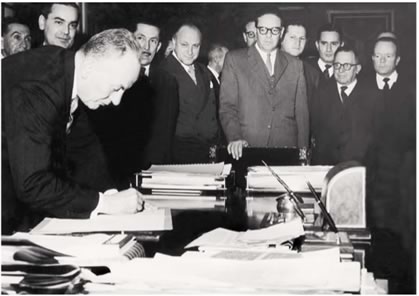 The growing company assumed the reverted assets of the Tropical Oil Company that began oil activities in 1921 in Colombia with the implementation of the Cira-Infantas Field in the Middle Magdalena River Valley, located some 300 kilometers northeast of Bogotá.In 1961, it assumed the direct management of the Barrancabermeja Refinery. Thirteen years later, it purchased the Cartagena Refinery, built by Intercol in 1956.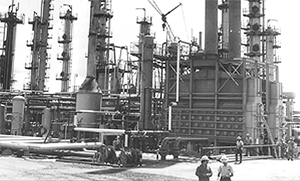 |
|
In September 1983, the best news for the history of Ecopetrol and some of the best news for Colombia was given: the discovery of the Caño Limón Field in association with OXY, a reservoir with reserves estimated at 1.1 billion barrels. Thanks to this field, the Company began a new era and in the year 1986, Colombia began to export oil again.During the 1990s, Colombia extended its oil self-sufficiency with the discovery of the Cusiana and Cupiagua giants in the Foothills of the Plains region, in association with the British Petroleum Company. |